 English
 Español
 Português
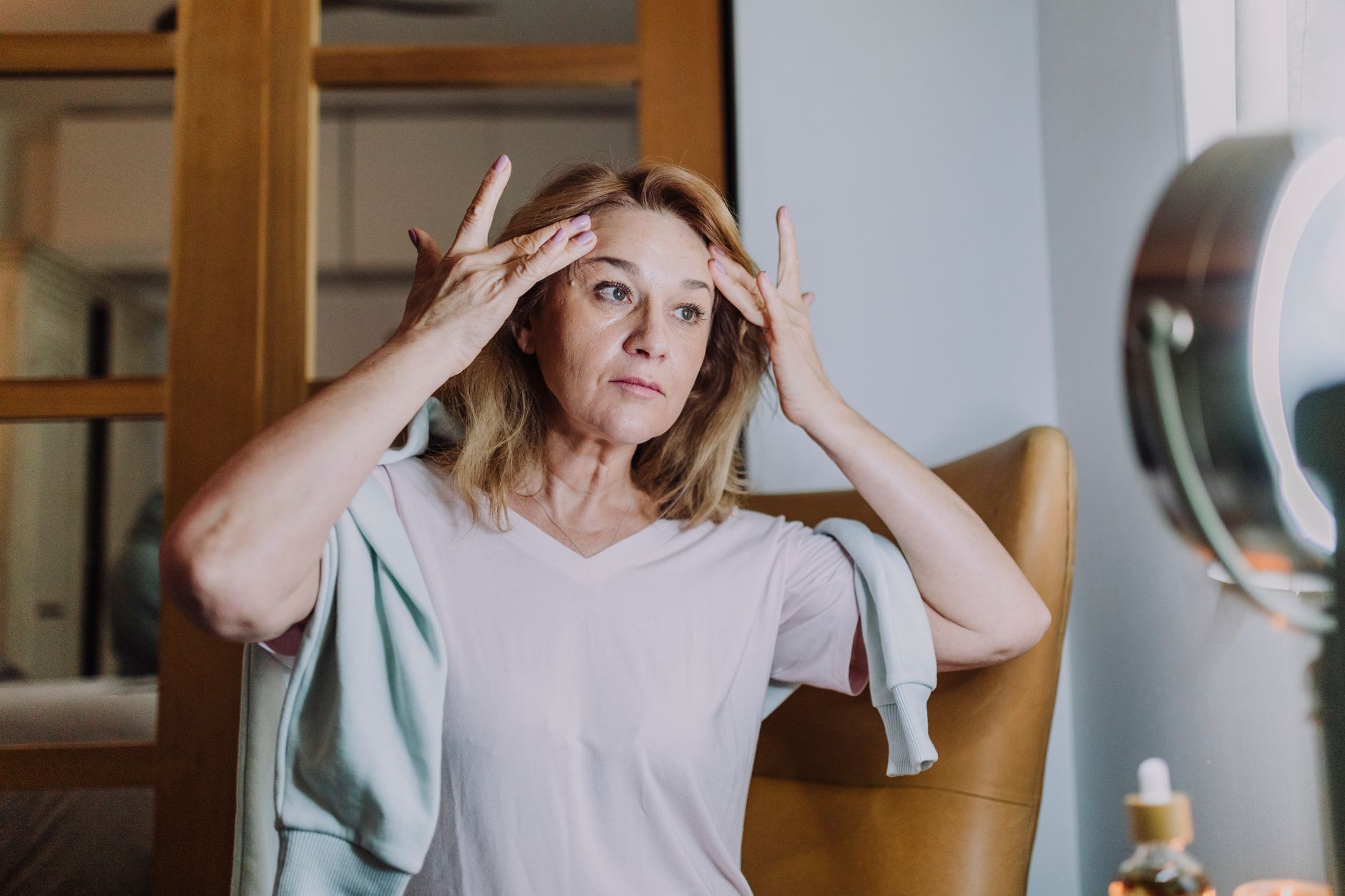
This article shares reflections and personal experiences. It is not health advice.
In this article
You wake up at 3 a.m. for no reason. Your period came two days early, or late, or skipped a month. A flash of irritation shows up over small things. And nobody, including your own mind, connects the dots. For many women, that is how perimenopause begins: not with a warning, but with a sum of small changes that seem unrelated.
This guide gathers the most common early signs of the transition, what else it could be, and when it's worth booking an appointment. It isn't a diagnosis. It's a map to help you walk into the conversation with your doctor better prepared.
The first sign is often the cycle
In perimenopause the ovaries keep working, but irregularly: estrogen and progesterone rise and fall without following a straight line. The most visible result is in your period. One criterion specialists use to recognize the start of the transition is a persistent difference of 7 days or more between the lengths of consecutive cycles. In other words, a 28-day cycle starts to range between 24 and 35, for example.
In practice it shows up in several ways:
- shorter cycles, with your period arriving earlier than you expect;
- longer cycles, or months when it simply doesn't come;
- a flow that differs from your usual, heavier or lighter;
- PMS that got stronger, with tender breasts and bloating.
Gaps of 60 days or more without a period usually point to a later stage of the transition.
The signs that have nothing to do with periods
This is where many women get lost. Some symptoms appear before the cycle clearly changes, and they're rarely linked to hormones. The ones most often listed by sources such as the UK's NHS are:
- worse sleep: trouble falling asleep, or waking in the small hours and not getting back to sleep;
- hot flashes and night sweats, sometimes mild, just a sudden heat in the face and chest;
- mood changes: irritability, anxiety, tearfulness, feeling "at the limit";
- brain fog: forgetting words, losing your train of thought, trouble concentrating;
- tiredness that a good night's sleep doesn't fix;
- aching joints and muscles with no effort to explain them;
- a racing heart (palpitations) and more frequent headaches;
- vaginal dryness and lower sex drive;
- urinary infections that come back more often.
Nobody feels all of these, and intensity varies widely. What usually stands out is the combination: several small signs showing up around the same time.
"If I still have a period every month, it can't be perimenopause."
It can. Many symptoms appear while periods still come, which is why so many women take a while to understand what is happening.
What women tell us
Personal experiences, shared to help you feel less alone. They are not health advice.
My menopausal cycle has become irregular. My body gets somehow hot. I sweat a lot. Then my skin dries up a bit ... I feel very tired. My energy has decreased a lot compared to the last few years.
I'm feeling changes in my body that are new to me. For example, now I feel hot and very tired. [...] I don't know whether it's due to menstruation or aging.
I cannot sleep comfortably at night. When I wake up in the morning, I feel tired and upset.
I give hope to myself that these will be temporary and over and I will feel well again.

Keep notes before you go to the appointment
If you suspect the transition is starting, the most useful tool is simple and free: a notebook. For two or three months, write down:
- the dates your period started and ended, and whether the flow was light, medium or heavy;
- how the night went (what time you woke up, whether you felt hot);
- your mood and energy for the day, from 1 to 5;
- anything that caught your attention: headaches, a racing heart, forgetfulness.
Bring your notes to the appointment. A doctor can spot a pattern in two months of records far faster than from memory.
Is it really perimenopause? What else it could be
Not everything that happens after 40 is perimenopause. Tiredness, poor sleep, unstable mood and a racing heart can also have other causes, such as thyroid problems, anemia, prolonged stress, depression or anxiety. And perimenopause can coexist with any of them.
So the point isn't to self-diagnose. It's to arrive with the full picture and let your doctor separate what belongs to what. According to NICE guidelines, in women over 45 with typical symptoms the diagnosis is made from the history and doesn't need a blood test. Between 40 and 45, or when there is doubt, tests may be requested.
Putting a name to what you feel already brings relief: it isn't weakness, it isn't lack of willpower, and you are not alone.
What helps day to day
Nothing here treats perimenopause, and every body responds differently. But some habits tend to make this stage more comfortable, and the NHS suggests them as a starting point:
- move your body on most days, with something you enjoy and can keep up;
- look after your bedroom: cooler, with layered bedding you can throw off;
- notice your hot-flash triggers, such as alcohol, caffeine, very spicy food and stuffy rooms;
- keep a regular bedtime, with no screens in the last hour of the day;
- talk about it with someone you trust. Saying it out loud lifts the weight of "I'm going crazy."
Supplements, "miracle teas" and hormone treatments are left out of this guide on purpose. Those are decisions to make with a doctor who knows your history.
When it is worth talking to a health professional
Get care without waiting if you have very heavy bleeding or large clots, bleeding between periods or after sex, or any bleeding after 12 months without a period. These signs always need to be checked.
It's also worth booking a visit if:
- symptoms began before age 40;
- sleep, mood or work are being affected;
- you feel deep discouragement or thoughts of hopelessness. If so, talk to someone today. If you're in the US, you can call or text 988, the Suicide & Crisis Lifeline, free and available 24 hours.
Some questions that can help: "Could my symptoms be perimenopause?", "What other causes are worth ruling out?", "What options exist for my case, with and without hormones?"
References
- NHS. Menopause: symptoms. nhs.uk
- NICE. Menopause: identification and management (NG23), 2015. nice.org.uk
- Harlow SD et al. Executive summary of the Stages of Reproductive Aging Workshop + 10 (STRAW+10). Menopause. 2012;19(4):387–395.
- Avis NE et al. Duration of menopausal vasomotor symptoms over the menopause transition. JAMA Internal Medicine. 2015;175(4):531–539.
- World Health Organization. Menopause (fact sheet), 2024. who.int
- Refaei M et al. Women's experiences in the transition to menopause: a qualitative research. BMC Women's Health. 2022;22:53. doi.org/10.1186/s12905-022-01633-0 (CC BY 4.0)
Frequently asked questions
At what age does perimenopause usually begin?
For most women, in their 40s. Some notice the first changes in their late 30s. If symptoms start before 40, it's worth seeing a doctor, because there may be another explanation.
Is there a blood test that confirms perimenopause?
Over 45, NICE guidelines (UK) say the diagnosis should be based on symptoms, without a test. Hormones swing from day to day in this stage, so a single result can mislead. Between 40 and 45, a doctor may consider tests case by case.
How long does perimenopause last?
It varies a lot. Some women move through it in a few years, others take longer. In a large US study (SWAN), hot flashes lasted a median of about 7 years, counting before and after the last period.
Can I still get pregnant during perimenopause?
Yes. Fertility declines but doesn't end while ovulation still happens, even irregularly. Talk to your doctor about how long to keep using contraception.
Can anxiety or stress be mistaken for perimenopause?
They can, and the reverse happens too. Symptoms overlap: poor sleep, racing heart, irritability. That's why it helps to give your doctor the full picture instead of trying to guess on your own.
Most relevant for: in your 40s