 English
 Português
This article shares reflections and personal experiences. It is not health advice.
In this article
This text is for information only. It is not medical advice and does not replace an assessment by a health professional.
The feeling of fading
Menopause and the years around it often coincide with children leaving home, changes at work, ageing parents and a shifting body. In a Spanish qualitative study on menopause care, women described living in a society "obsessed with youth and beauty" in which women of their age become invisible. Researchers frame this less as vanity than as a question of being seen, valued and included.
The experience is widely reported but not universal. How strongly it is felt appears to depend on social context, work situation, relationships and cultural messages about ageing.
A threshold with two sides
In several qualitative studies, women describe menopause as a new chapter. Some report relief, wisdom and emotional growth; others describe grief at changes in body, fertility and identity. Research accounts often present both at once rather than one replacing the other.
"After fifty, the best part of life is over."
Studies of women in midlife and later report confidence, freedom and purpose alongside losses. Ageing is commonly described as involving both gains and losses rather than a single direction.
What women tell us
Personal experiences, shared to help you feel less alone. They are not health advice.
[..] we live in a society so obsessed with youth and beauty that when we get to this age, we become invisible.
You feel like a different person…like something’s being taken away from you. So, I feel like I’m not the person that I used to be.
At the same time, […] I see it as a new chapter in a woman’s life, characterized by heightened wisdom and emotional growth
What research participants describe
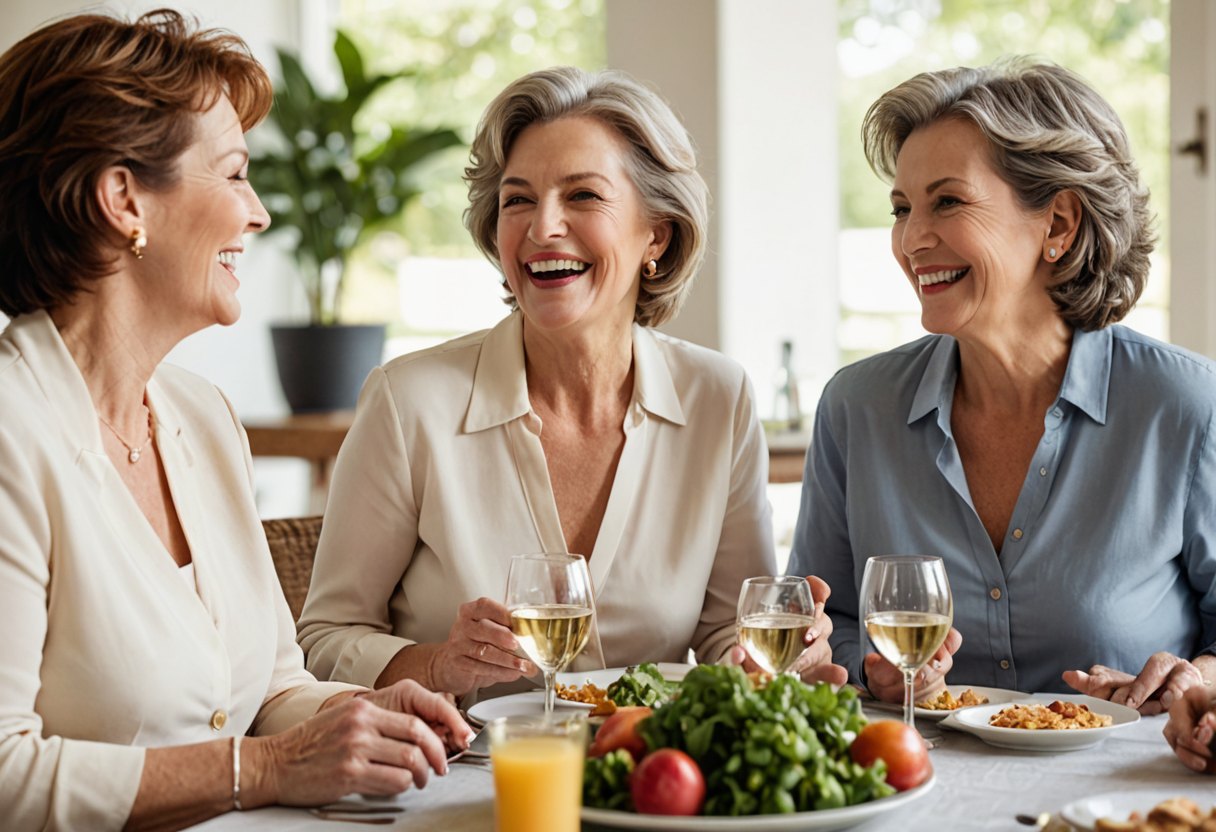
Peer contact. Women in qualitative studies frequently mention that talking with others of similar age reduces a sense of isolation. This is a reported experience, not a prescribed treatment.
Purposeful activity. Learning, volunteering, creating, mentoring or starting something new appear in accounts of women who describe feeling more present in midlife.
Body care. Sleep, movement, nutrition and routine check-ups are general health topics that public health bodies address for all adults, including those over 50.
Media and images. Researchers note that limited, youth-focused representations of ageing shape how women see themselves; exposure to diverse images of older women is discussed as a factor in self-perception.
Inner voice. Self-criticism about appearance and age is commonly described in psychological literature on midlife, and is studied as a pattern rather than a personal failing.
A common scenario (illustrative)
Consider a composite example: a woman who feels overlooked at work and at social events joins a walking group of women her age, takes a pottery class and begins mentoring a younger colleague. Over time she describes feeling more present and valued. This is an illustrative composite, not a real account or a study finding.
When it is more than a mood
Persistent low mood, anxiety, hopelessness or thoughts of self-harm are health concerns that require assessment by a doctor or mental health professional. Hormonal changes, life stress and depression can overlap, and clinical guidance addresses these as distinct but sometimes connected issues. Helplines by country are listed by Find a Helpline.
What public sources say about midlife wellbeing
The World Health Organization notes that mental health in older adults is shaped by social, psychological and biological factors, including isolation, loss and changing roles. NHS and NICE guidance on menopause describes mood changes as a recognised symptom and notes that they can overlap with other conditions, which is why clinical assessment is part of the guidance.
Research on identity in midlife commonly describes a process of revising what no longer fits — roles, expectations, friendships — rather than a single decision. Therapy is described in the literature as one setting in which change, identity and relationships are explored with a trained professional.
Ageing is not erasing. It is a chance to decide what to carry forward.
Talking to a professional
Several kinds of professionals work with questions of ageing, identity and mood: general practitioners, gynaecologists with an interest in menopause, psychologists, psychotherapists and counsellors. Their roles differ — medical assessment, diagnosis, talking therapy — and in many countries referral pathways determine who is seen first. What these professionals offer is a structured setting in which symptoms, history and circumstances are reviewed, and in which options are discussed rather than prescribed by default.
References
- NHS. Menopause: symptoms. nhs.uk
- NICE. Menopause: diagnosis and management. nice.org.uk
- World Health Organization. Mental health of older adults. who.int
- Find a Helpline. findahelpline.com
Frequently asked questions
Is it common to fear ageing?
Yes. Qualitative research and public health literature describe fear of ageing and feelings of invisibility as common experiences, particularly in cultures that prize youth.
Does menopause cause these feelings?
Menopause can coincide with mood changes, and NHS and NICE guidance list mood symptoms among recognised menopausal symptoms. Many other factors — work, relationships, loss, health — also contribute, and clinical guidance notes that these can overlap.
Do women report positive aspects of this stage?
Yes. In several qualitative studies, participants describe relief, wisdom, emotional growth and a sense of a new chapter, often alongside grief.
Can therapy help with grief and identity?
Therapy is described in psychological literature as a setting for exploring grief, anxiety, identity and relationships with a trained professional. Whether it is appropriate in an individual case is a matter for clinical assessment.
Where can someone find support in a crisis?
Find a Helpline lists crisis and support lines by country.
Most relevant for: in your 50sin your 60s